
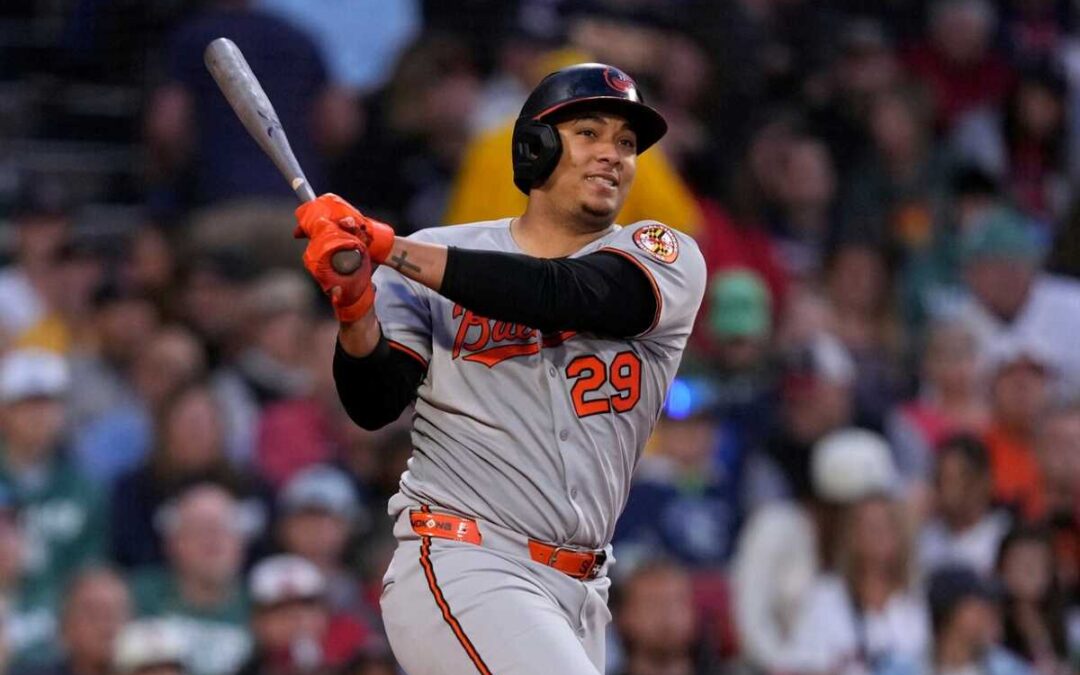
Welcome to Beyond the Rankings, a RotoProspects series that follows Top 700 prospects from the scouting-report hype that got them here to the moment they graduate off the list. Each entry tracks the player’s road to the majors, the exact point he crossed the graduation threshold (130 at-bats for hitters, 50 innings for pitchers), and how his season has unfolded since.
The road to Baltimore
Samuel Basallo‘s path to the majors started far from a box score. Signed out of the Dominican Republic in 2021 for $1.3 million, the left-handed-hitting catcher climbed steadily through Baltimore’s system, jumping from Low-A to Double-A as an 18-year-old and reaching Triple-A just after his 20th birthday. By the summer of 2025 he was the best hitter in the minor leagues by most evaluators’ accounts, batting .270/.377/.589 with 23 home runs in just 76 games for Triple-A Norfolk — production that made him the consensus No. 1 catching prospect in the sport for a second straight year.
The Orioles were deliberate about his timeline. Even as a rash of catcher injuries hit the big-league roster in June and July 2025, Baltimore held Basallo back at Triple-A, and the delay wasn’t an accident: keeping him down until the season’s final 45 days let him debut on August 17, 2025, without accruing enough service time to lose his rookie eligibility for 2026. He made an immediate mark, getting hit by a pitch in his first career plate appearance — the first such occurrence in Orioles history — but the rest of his 31-game cameo was rough, a .165/.229/.330 line as the youngest catcher in the majors. Less than a week after that debut, Baltimore signed him to an eight-year, $67 million extension (capable of reaching $88.5 million with a club option), the largest pre-arbitration deal ever given to a catcher.
Crossing the graduation threshold
Because Basallo’s 2025 cameo left him with 109 at-bats, just under the 130-AB cutoff, he carried a head start into 2026 instead of starting the clock over. He needed only about 21 more at-bats to cross the threshold, which he did during the sixth game of the season on April 3, officially graduating him off the Top 700 rankings.
How he’s performed
Basallo’s season had a strong first act and a rough finish. He hit .333 with three home runs in spring training and carried it into the year, and by the end of May he was sitting at .283/.345/.516 with nine home runs. May alone was the best month of his career to that point, with a .338 average, four homers and a .974 OPS, and he ranked among the top ten AL catchers in average, homers and WAR at the time.
That turned out to be the peak. He slumped through June and July, then lost a month to a right shoulder injury: he went on the injured list for the first time in his career on July 22 with shoulder inflammation, got a cortisone injection, and was activated on August 19. His production never recovered in August or September.
The Orioles’ catching picture changed while he was out. On August 3, Baltimore traded Adley Rutschman and Jake Rogers to the Red Sox, a move that made Basallo the club’s No. 1 catcher the moment he returned.
His final line: .222/.291/.406 (.696 OPS) with 80 hits in 360 at-bats, 10 doubles, a triple, 18 home runs, 54 RBI, 40 runs scored and 32 walks across 112 games. He struck out 106 times (26.6%) against an 8.0% walk rate. The power was legitimate: Statcast had his average exit velocity at 90.4 mph with a 12.1% barrel rate and a hard-hit rate near 43%. The contact and chase issues are what held the average down.
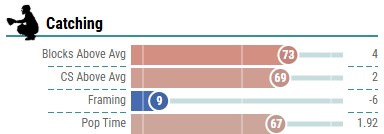
Behind the plate, the early returns were encouraging. Basallo graded well in Statcast pitch-blocking metrics, showed a good pop time that helped control the running game, and emerged as Trevor Rogers‘ preferred catcher. He caught 75 games and also played first base and DH. In the ABS challenge system he went 30-for-60, an even split, but he challenged only about 19% of eligible mistakes, which dragged down his grade.
The bottom line
Basallo’s first full year looked like the profile scouts described: real power, a rough contact profile and a catcher still learning the job. A hot spring and a strong May showed what the bat can do, and the second-half slump and shoulder injury showed how far he has to go. With Rutschman gone, the playing time is his in 2027, but how often he should catch, and whether he can chase less and find better launch angles, are the questions that will define his next step. He’s ranked inside the Top 75 in our latest Top 700 Dynasty Rankings, so the upside is immense.