
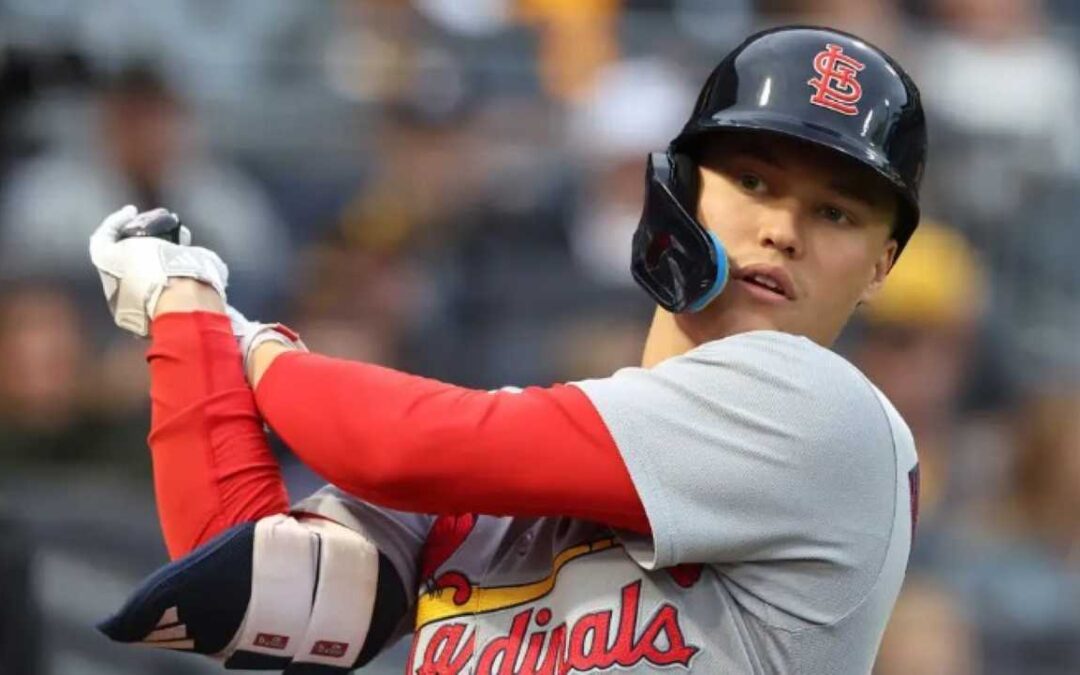
Third in Beyond the Rankings, a RotoProspects series that follows Top 700 prospects from the scouting-report hype that got them here to the moment they graduate off the list. Check out the first two posts on Konnor Griffin arriving ahead of schedule and Kevin McGonigle making Detroit’s decision look easy. Each entry tracks the player’s road to the majors, the exact point he crossed the graduation threshold (130 at-bats for hitters, 50 innings for pitchers), and how his season has unfolded since.
The road to St. Louis
JJ Wetherholt‘s path to the majors started with a snub. Undrafted out of high school in Mars, Pennsylvania, he went to West Virginia and won a Division I batting title as a sophomore, hitting .449, and was in the conversation for the No. 1 overall pick in the 2024 draft before a hamstring injury clouded his stock. He still went seventh overall to the Cardinals, and he wasted little time proving the batting title wasn’t a fluke.
Wetherholt’s 2025 minor league season was a study in rapid ascent. He opened at Double-A Springfield and hit .300 with seven home runs in 62 games, good enough to be named the Texas League’s Most Valuable Player, then got bumped to Triple-A Memphis on July 7 — becoming the first Cardinals position player to reach Triple-A within a calendar year of being drafted since 2009. He was even better there, batting .314 with 10 home runs in 47 games and posting a wRC+ that outpaced touted prospects like Roman Anthony.
St. Louis entered its 2026 rebuild with Wetherholt as the centerpiece, and after a solid spring, the club — which had traded away veterans like Nolan Arenado and Willson Contreras to get younger — named him its Opening Day second baseman. He delivered immediately: a home run in his first career at-bat on March 26, then a walk-off two-run single in his second game, a feat no player in MLB history had accomplished in a debut and follow-up.
Crossing the graduation threshold
Wetherholt cleared the 130-at-bat mark on May 4, officially graduating him off the Top 700 rankings.
How he’s performed
Wetherholt’s first half was arguably better than his prospect pedigree suggested. By mid-July he was hitting .267/.362/.411 with 13 home runs, 36 RBI and 9 steals, leading all NL rookies with 3.8 bWAR, 56 runs and 140 times on base, while also pacing all qualified second basemen in assists and ranking second in outs above average. St. Louis moved quickly to lock that up, signing him to an eight-year, $112.5 million extension on July 10 — a deal that can max out at $132 million with incentives and runs through 2034, the largest the Cardinals have ever given a player before arbitration eligibility, topping even Albert Pujols’s pre-2004 deal.
The second half was tougher. Wetherholt battled right wrist tendinitis for roughly a month, and his production sagged noticeably as he tried to play through it, a .201/.313/.305 line with just 4 home runs over 40 games before the Cardinals placed him on the 10-day injured list on August 30. He missed 15 games before being activated on September 16, and he closed out the year with 12 games in the final month, adding nine hits, a double and three RBI.
His final line: .242/.339/.365 with 17 home runs, 51 RBI, 89 runs scored, 64 walks and 14 stolen bases in 15 attempts across 139 games and 537 at-bats, good for a 101 wRC+ and 4.6 WAR per FanGraphs (4.5 per Baseball Reference). That made him the most valuable position-player rookie in the National League by WAR. The underlying metrics were kinder than the batting average: his .347 expected wOBA sat well above his actual .318 mark, and he ranked in the 75th percentile or better in hard-hit rate, strikeout rate and baserunning value.
Where Wetherholt truly separated himself was in the field. After moving over from shortstop, he posted a +23 fielding run value, the best of any major league second baseman and second in all of baseball behind only the Cubs’ Pete Crow-Armstrong. His 25 outs above average set a rookie record in the metric’s history (dating to 2016), and he finished as a Gold Glove finalist at second base. He also filled in at shortstop when Gold Glove winner Masyn Winn went down injured. At the plate, he set a Cardinals franchise record with four leadoff home runs by a rookie.
Wetherholt was named one of three NL Rookie of the Year finalists alongside the Mets’ Carson Benge and the Reds’ Sal Stewart, and he finished third in the voting with 99 points, including three first-place votes.
The team results didn’t match the individual ones. St. Louis finished 77-85, tenth in the National League and 11 games out of the final wild-card spot, in a season that saw the Cardinals debut 13 rookies as the club leaned into its youth movement.
The bottom line
Wetherholt’s rookie year was a good one that looked even better through a defensive lens. He wasn’t the batting-average machine his college numbers promised, and the wrist injury cost him a chunk of the second half, but a high-OBP bat, plus baserunning, record-setting range at second base and a franchise-record extension make him a foundational piece for St. Louis heading into 2027. If the wrist is healthy and some of that .347 expected wOBA turns into real production, the offensive line has room to climb.