
First in Beyond the Rankings, a RotoProspects series that follows Top 700 prospects from the scouting-report hype that got them here to the moment they graduate off the list — and, more importantly, what they’ve actually done once big-league pitching stopped grading on a curve. Each entry tracks the player’s road to the majors, the exact point he crossed the graduation threshold (130 at-bats for hitters, 50 innings for pitchers), and how his season has unfolded since.
The road to Pittsburgh
Konnor Griffin was never supposed to still be a prospect this long. A Mississippi high schooler who reclassified a grade to enter the 2024 draft a year early, Griffin was the consensus best prep bat in his class and still fell to the Pirates at No. 9 overall, picking up a well-over-slot bonus in the process. From the moment he signed, evaluators talked about him in tools-across-the-board terms: plus-plus speed, a plus-plus arm, and raw power that only grew louder as he filled out his 6-foot-3 frame.
The 2025 minor league season is what turned Griffin from “exciting prospect” into the unanimous No. 1 in the sport. Playing across three levels — Low-A Bradenton, High-A Greensboro and Double-A Altoona — as an 18-year-old, he hit .333/.415/.527 with 21 home runs, 65 stolen bases and 117 runs scored in 122 games, numbers that earned him Baseball America’s Minor League Player of the Year award.
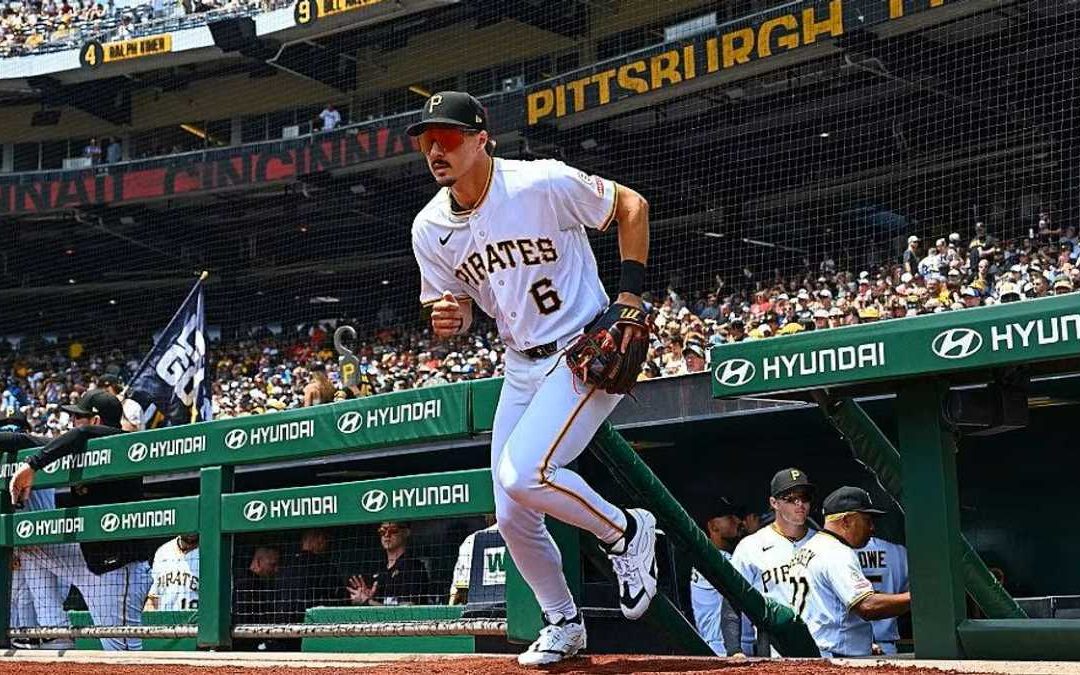
He entered 2026 spring training with a real shot at making Pittsburgh’s Opening Day roster, and while a slow spring (he hit just .171 in 41 Grapefruit League at-bats) pushed the decision back, the Pirates didn’t wait long. After a 12-day Triple-A tune-up, Griffin was in the lineup at shortstop for Pittsburgh’s home opener on April 3 against Baltimore — and delivered an RBI double in his first big-league at-bat.
Days later, the Pirates locked him up with a nine-year, $140 million extension, the largest contract ever given to a player who hadn’t yet debuted in the majors.
Crossing the graduation threshold
Griffin cleared the 130-at-bat mark for hitters in early May, roughly a month into his big-league run, officially graduating him off the Top 700 rankings and into “MLB player” territory for good.
How he’s performed
Across 59 games and 225 at-bats before his injury, Griffin was hitting .276/.332/.404 with 62 hits, 5 home runs, 25 RBI, 35 runs scored and 20 stolen bases in 21 attempts. Since returning from the injured list, he’s played in 16 games and his season line as the season winds down sits at .271 with 5 home runs, 31 RBIs and 23 stolen bases. He has shaken off the rust, though the power is still lagging. His 98th percentile speed has been the carrying card so far.
The early scouting report has otherwise held up: the speed has translated immediately (he’s been caught stealing just three times), while the power is still trending toward projection rather than production. His plate discipline remains a work in progress, with a strikeout rate north of 26% against a walk rate in the high single digits — numbers typical of a teenager skipping so many developmental reps to face big-league arms directly out of Double-A.
Defensively, he’s held his own at a premium position, posting a positive fielding-runs mark and a strong range factor relative to league average, suggesting his glove won’t force a quick move off shortstop the way some evaluators once projected.
The season has been interrupted twice by injury. Griffin missed most of June with a right forearm strain, then, shortly after returning, tore the sagittal band in his left ring finger on July 5 against Washington — an injury serious enough to require six weeks of immobilization and a trip to the 60-day injured list.
He worked back through a rehab assignment at Double-A Altoona and Triple-A Indianapolis in late August and was activated on September 4, returning to Pittsburgh’s starting lineup for a series against the Angels. “It’s been driving me nuts watching the games on my phone,” Griffin said of the layoff. “It’ll be fun to finally be back in there competing.”
The bottom line
For a player who was a teenager on Opening Day, Griffin’s rookie season has looked almost exactly like advertised: explosive on the bases, promising in the field, and still figuring out professional pitching at the plate — with two separate injuries costing him real developmental time in the middle of the year. With Griffin back in the lineup for Pittsburgh’s stretch run, the tools, and the nine-figure extension, suggest the Pirates are playing the long game here, and the early returns say that bet was a reasonable one to make.