
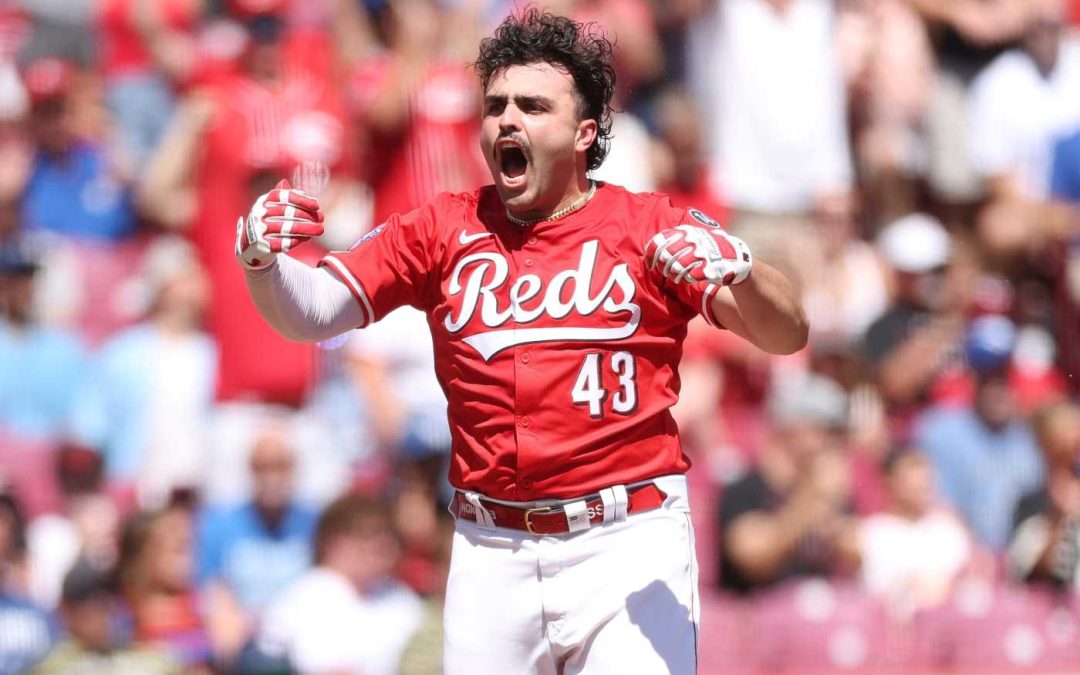
Fourth in Beyond the Rankings, a RotoProspects series that follows Top 700 prospects from the scouting-report hype that got them here to the moment they graduate off the list — and, more importantly, what they’ve actually done once big-league pitching stopped grading on a curve. Each entry tracks the player’s road to the majors, the exact point he crossed the graduation threshold (130 at-bats for hitters, 50 innings for pitchers), and how his season has unfolded since.
The road to Cincinnati
Sal Stewart‘s amateur career reads like a power-hitting fever dream: a .514 average with 30 home runs across his high school career at Westminster Christian in Miami, plus a commitment to Vanderbilt he never got to use. The Reds took him with a compensation pick (32nd overall) in 2022 after Nick Castellanos left in free agency, betting on a bat-first corner infielder who’d need to find a defensive home.
He found it, more or less, playing his way from third base to first while also getting run at second, all in the name of keeping his bat in the lineup. The profile — plus raw power, a contact rate that stayed strong at every level, strikeout rates that never spiked out of control — carried him steadily through Cincinnati’s system, culminating in a .907 OPS across Double-A and Triple-A in 2025 that forced the Reds’ hand. They promoted him on September 1, and he immediately made an impression, going 1-for-3 with a run scored in his debut and adding a walk-off assist during Cincinnati’s stretch run to the postseason. In 18 games down the stretch, he hit .255 with five home runs and helped the Reds reach October for the first time since 2020.
Crossing the graduation threshold
Stewart’s path to graduation is a little different from the others in this series — he’d already banked 55 at-bats during that September 2025 cameo, so instead of needing a full 130 at-bats as a rookie, he only needed to add roughly 75 more once the 2026 season opened. He got there in mid-to-late April, just a few weeks into his first full big-league season, officially graduating him off the Top 700 for good.
How he’s performed
Stewart started the year as a hitter who looked like he belonged. He homered twice against Boston ace Garrett Crochet in the opening series, took home NL Rookie of the Month honors for April, and earned a first All-Star selection. He had shed more than 25 pounds over the winter to help him handle first base, and the bat carried over: he led the Reds in home runs, RBI, hits and games played.
The milestones piled up. Stewart drove in his 100th run on August 26, tying Jim Greengrass’s 1953 franchise record for RBI by a Reds rookie, then broke it outright two days later. He became the first rookie in the majors to reach 100 RBI since Pete Alonso in 2019 and the first Reds rookie with a 30-homer, 100-RBI season. His 32 home runs were the most by a Reds rookie since Frank Robinson hit 38 in 1956.
His final line: .263/.330/.457 (.787 OPS) with 164 hits in 623 at-bats, 32 home runs, 112 RBI, 87 runs scored and 15 stolen bases, with a 117 OPS+ and 112 wRC+. He played all 162 games, one of only seven major leaguers to do so, and logged 117 games at first base, 45 at third and eight at second. He led all NL rookies in home runs and RBI, and the RBI total was a Reds rookie record.
The season wasn’t all upside. Stewart’s advanced numbers lagged his counting stats: his 2.0 WAR sat well behind rival Wetherholt’s 4.6, and his bat cooled late, with a .536 OPS over his final 19 games. His RBI total also ranked behind the Cardinals’ Alec Burleson (116), who led the majors.
The Rookie of the Year verdict
That debate shaped the awards race, but the voters sided with the power and the production. On November 9, Stewart was named NL Rookie of the Year with 170 points and 20 of 30 first-place votes, ahead of the Mets’ Carson Benge (107) and the Cardinals’ JJ Wetherholt (99). He’s the first Reds player to win the award since Jonathan India in 2021 and the ninth in franchise history.
The bottom line
Stewart delivered the run-producing season Cincinnati hoped for, and he did it as a 22-year-old playing every game while learning a new position. The team around him didn’t hold up: the Reds opened 20-11, then slid to 75-87, finished last in the NL Central and missed the postseason a year after reaching it, while posting the lowest team batting average and on-base percentage in the majors. The advanced numbers say there’s room for him to grow, but a Rookie of the Year trophy, a 30-homer, 100-RBI debut and a full season of everyday durability make him a core piece for the Reds heading into 2027.