
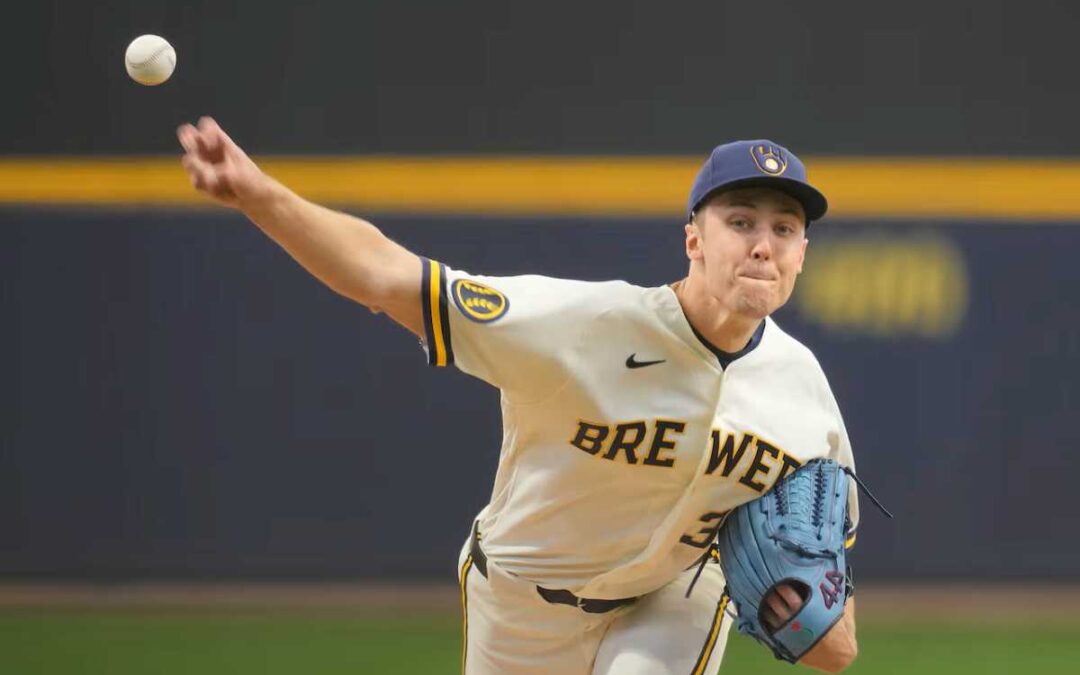
A year ago, Jacob Misiorowski was a hard-throwing rookie who faded down the stretch and spent October in relief. This year he went 16-5 with a 1.80 ERA, won the NL Cy Young Award unanimously, and then started two games in the World Series as the Brewers won the first title in franchise history. Those results have moved him up to No. 9 in our latest Top 700 Dynasty Rankings.
The 2026 season by the numbers
Misiorowski led the majors in ERA (1.80), strikeouts (252), WHIP (0.80) and opponent batting average (.157) across 30 starts and 174⅔ innings. He also led in strikeout rate (37.9%) and K/9 (12.98), and his 2.17 FIP and 232 ERA+ tell the same story. Baseball-Reference had him at 6.4 WAR, while FanGraphs had him at 6.6.
The historical comparisons are striking. His .157 opponent average beats Pedro Martínez’s 2000 mark of .167, and his 0.80 WHIP matches Justin Verlander’s 2019 season. His 252 strikeouts are the second-highest total in Brewers history, behind Ben Sheets’ 264 in 2004. Milwaukee won 103 games, the most in baseball, and went 22-8 in his starts. He picked up 18 quality starts, and all 30 first-place Cy Young votes.
What changed under the hood
The velocity is the headline. His four-seamer averaged 100.6 mph, he threw it about 63% of the time, and he topped out at 105.5 mph in June. He threw more pitches at 101 mph or faster than every other pitcher combined from 2008 through 2026.
The more important development is command. He cut his walk rate to 6.6% while keeping the strikeout rate near 38%, and that combination separates a highlight reel from an ace. His season also settled down quickly. After a 3.31 ERA through his first six starts, he posted a 1.46 ERA over 142 innings in his final 24 starts. That stretch is a big contrast with the 5.36 ERA he carried over his last 10 outings of 2025.
The October run
The postseason was less dominant but just as important. Misiorowski made four starts and posted a 1.89 ERA across 19 innings. His NLDS opener began with a 104.8 mph strike to Fernando Tatis Jr., the fastest postseason pitch since tracking began in 2008, but the Padres fouled off enough pitches to chase him after four innings. In NLCS Game 1 he ground through 13 outs of one-run ball without his best stuff.
In the World Series he went 2-0 with a 0.84 ERA over 10⅔ innings, holding the Rays to one run over five innings in Game 1 and earning the win in the Game 5 clincher. He struck out only five in the Series, but he averaged 101.1 mph in Game 5 and pitched his way through it. For a 24-year-old, that kind of poise is encouraging.
Dynasty outlook
The case for a Top 10 ranking is straightforward. He’s 24, he has an elite strikeout rate with improving command, and he’s already won a Cy Young. Strikeout upside this high is rare, and he’s cleared the hurdles that stop most power arms: the first full season, the second-half fade, and the postseason stage.
The risks are real, though. His workload jumped to 193⅔ innings across the regular season and playoffs, up from 141⅓ in 2025, and the five strikeouts in the World Series suggest some wear by the end. Extreme velocity also carries a higher injury risk than most profiles. Even regression to a more normal level would leave him among the best pitchers in the sport, since his FIP of 2.17 suggests the 1.80 ERA wasn’t luck.
For dynasty managers, he’s the type of pitcher you build a staff around. A second straight award in 2027 would make him the NL’s first back-to-back Cy Young winner since Jacob deGrom in 2018 and 2019.