
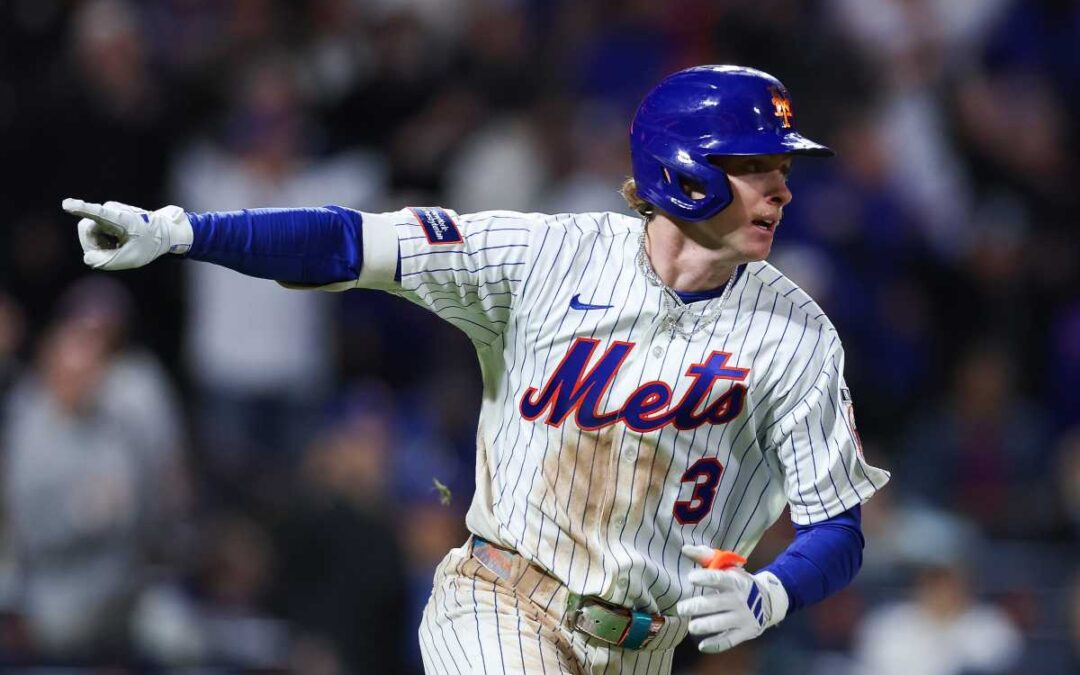
Welcome to Beyond the Rankings, a RotoProspects series that follows Top 700 prospects from the scouting-report hype that got them here to the moment they graduate off the list. Each entry tracks the player’s road to the majors, the exact point he crossed the graduation threshold (130 at-bats for hitters, 50 innings for pitchers), and how his season has unfolded since.
The road to Queens
Carson Benge arrived at Oklahoma State as a two-way player, and he was good at both jobs. Tommy John surgery wiped out his 2022 season, but he came back to hit .335 with 18 home runs and 64 RBI in 2024 while also posting a 3.16 ERA over 37 innings. The Mets made him the 19th overall pick that summer, and once he was drafted he announced he would focus on being an outfielder, a choice that let him develop as a position player only. He signed for about $4 million.
His first full pro season, 2025, was the kind that shoots a prospect up the rankings. He started at High-A Brooklyn and hit .302 with a .897 OPS over 60 games, then was promoted to Double-A Binghamton on June 23, where he hit .317/.407/.571 with eight home runs in 32 games. That earned him a spot in the Futures Game and a Triple-A promotion in August, where the league finally pushed back: he hit .178 with a .583 OPS in 24 games at Syracuse. He still finished the year at .281/.385/.472 with 15 home runs and 22 stolen bases across three levels, and the Mets named him their Minor League Player of the Year.
Heading into 2026, Benge was ranked as the No. 2 prospect in the Mets’ system and among the top 20 in the sport. After hitting .366 in spring training, he made the Opening Day roster on March 23, and the Mets selected his contract two days later. He debuted on March 26 and went deep, walked twice and stole a base in his first game.
Crossing the graduation threshold
Because Benge broke camp with the big club, the clock started on Opening Day. He crossed the 130 at-bat mark in mid-May, roughly 40 games into the season, which officially graduated him off the Top 700 rankings. He got there during the most uncomfortable stretch of his young career, with a batting average still hovering around .200.
How he’s performed
Benge’s rookie year had two distinct chapters. Over his first 21 games he hit just .136/.219/.197 with two extra-base hits, and the Mets stuck with him anyway. After the slow start, he never really looked back: from April 23 through the end of the season, he hit .301/.361/.459 over 135 games with 19 home runs, 62 RBI and 16 stolen bases.
His final line was .282/.346/.430 (.776 OPS) with 168 hits, 22 doubles, three triples, 20 home runs, 65 RBI, 86 runs scored and 22 stolen bases in 27 attempts across 156 games, good for a 118 OPS+ and 4.3 WAR. That was second among NL rookies behind JJ Wetherholt (4.5 bWAR).
The counting numbers made Mets history. Benge set the franchise’s rookie record for hits with 168, passing Pete Alonso, and became the first Mets rookie to hit 20 home runs and steal 20 bases in the same season. He joined Alonso as the only Mets rookies to reach 4.0 bWAR.
He also did serious work in right field. Benge notched 10 outfield assists, tied for sixth in the majors, and his arm value ranked in the 100th percentile. He was a Gold Glove finalist and was named to MLB.com’s All-Rookie First Team and All-Debut Team.
His one real weakness was strikeouts, with 142 in 654 plate appearances (21.7%), but a 7.6% walk rate and plus speed kept him productive.
The Rookie of the Year verdict
Benge finished second in the NL Rookie of the Year voting with 107 points and seven first-place votes, behind Reds first baseman Sal Stewart (170 points, 20 first-place votes) and ahead of Wetherholt (99 points). The race came down to a debate over power versus all-around value: Stewart hit 32 home runs with 112 RBI but posted a lower WAR, while Benge’s case rested on defense, baserunning and a steady bat.
The bottom line
Benge’s season is a good example of why teams stay patient with prospects. He looked overmatched for three weeks, kept getting the ball, and by the end of the year had the best rookie hit total in Mets history and a runner-up finish in the Rookie of the Year voting. A right fielder with a plus arm, 20/20 production and a sub-22% strikeout rate, he looks like a lineup fixture for the Mets in 2027 and beyond.