
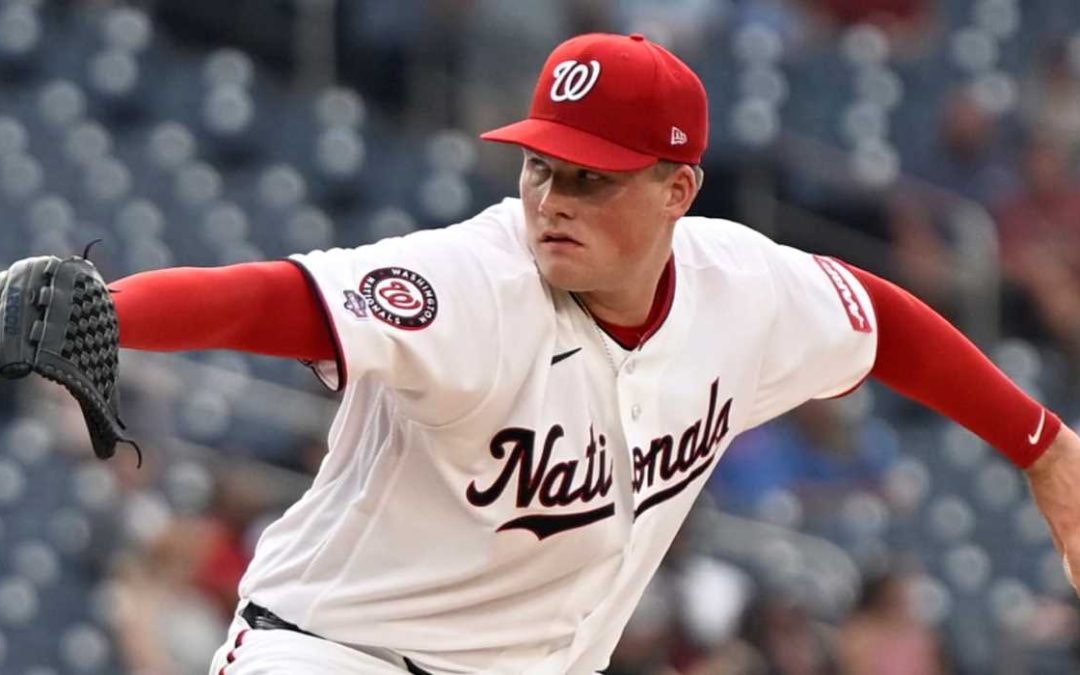
Baseball debuts rarely come with a clean storyline, and Jackson Kent‘s certainly didn’t hand fantasy baseball managers one either. The Nationals’ No. 8 prospect opened his career Wednesday night against the Cubs by striking out the side in the first inning — three swings, three misses, the kind of start that makes a broadcast crew reach for superlatives and fantasy baseball waiver wires light up. By the fourth inning, he’d walked five Cubs, allowed three runs, and was watching from the dugout as Washington’s bullpen tried to hold down a game that eventually got away, 12-6.
That’s not a feel-good headline. It’s a real one, though — and honestly, the real story here is more interesting than a tidy one would’ve been, fantasy baseball implications and all. Let’s get into it.
The path: a Friday night arm out of the Pac-12
Kent came up through the Chicago suburbs (Hanover Park, Illinois) before landing at Arizona, where he spent most of 2024 as the Wildcats’ Friday night starter — the college pitching equivalent of being handed the keys. It was a legitimate breakout: 15 starts, an ERA a shade over 4.00, and 89 strikeouts in 86 innings while helping Arizona to a Pac-12 regular-season and tournament title. His velocity ticked up noticeably that spring, sitting 90-92 and touching 95-96 after working in the upper 80s the year before — the kind of jump that gets scouts (and fantasy baseball prospect hounds) recalculating a guy’s ceiling mid-season.
Washington popped him in the fourth round (108th overall) in 2024, signing him for $625,000 — over slot value, a signal the Nats liked him more than his draft position suggested. The profile going in: a physical 6-foot-3 lefty with a four-pitch mix, led by a changeup that already graded as his best offering.
The pro track record has been steady rather than spectacular. Across 44 minor league starts, Kent went 16-14 with a 4.22 ERA, climbing from Double-A Harrisburg to Triple-A Rochester. This season specifically, he posted a 3.72 ERA with 105 strikeouts in 94⅓ innings between the two levels — strong enough that when Washington needed rotation help in August, with Zack Littell already released and Miles Mikolas designated for assignment to clear the roster spot, Kent’s number got called instead of a more established veteran arm.
Manager Blake Butera set the tone honestly beforehand: “There will be nerves. There will be excitement, of course. There’s no way to hide that. I want him to go out there and make the most of it. You only get one debut and you’re lucky to have it because a lot of people want it.”
The scouting report: a changeup you can dream on
Our line on him, 20-80 scale: 55 Fastball / 40 Curveball / 50 Slider / 60 Changeup / 45 Future Value. That’s a profile with a clear carrying tool, a real weakness, and a future value that says “back-end starter or good reliever” more than “frontline arm” — which, for a fourth-round college lefty, is a perfectly respectable outcome if it holds.
Fastball — 55: Above-average, and it’s the part of his game that’s genuinely improved the most as a pro. He was sitting upper-80s as a college sophomore and now works in the low 90s with the ability to reach back for more — the added life shows up as a real weapon when he’s locating it, which, per his debut, isn’t a given yet.
Curveball — 40: The clear soft spot in the mix. A below-average grade on a fourth pitch isn’t unusual — most starters carry one pitch that’s more “show-me” than out-pitch — but it does mean Kent’s margin for error against a patient lineup gets thinner if the other three aren’t working.
Slider — 50: Average, functional, gets the job done without beating anybody. A pitch that plays a supporting role rather than a starring one, which is exactly what you want from your third-best secondary.
Changeup — 60: This is the pitch. Scouts pegged Kent’s changeup as one of the better offerings in the system even back in his Arizona days, and a 60 grade puts it firmly in plus territory — the kind of pitch that keeps same-handed and opposite-handed hitters honest and is usually the separator between “fringe starter” and “guy who sticks.”
Future Value — 45: Below-average-to-average, which tracks with a fourth-rounder who’s had a solid-but-unspectacular pro track record (16-14, 4.22 ERA across the minors). It’s a grade that leaves real room to move if the fastball/changeup combo plays as well against big-league hitters as it has against minor-league ones — but it’s also a grade that says the walks need to come down, because a 45 FV profile doesn’t have a lot of margin for a 5-walk night, fantasy baseball streaming candidate or not.
The debut: swing-and-miss stuff, fastball-command problems
Kent’s first big-league start came against a Cubs lineup that, entering the night, had posted the best OBP, slugging, and wRC+ against left-handed pitching in all of baseball — not exactly a gentle welcome for a 23-year-old debuting at home in front of family. He also happened to grow up a Cubs fan, for what it’s worth.
The swing-and-miss stuff showed up immediately: three strikeouts in the first inning alone, six for the night — the kind of strikeout upside that gets a name circulating on fantasy baseball forums regardless of the final line. But the command didn’t follow — five walks put traffic on the bases all night, and the Cubs eventually broke the game open with a five-run sixth off the bullpen after Kent was out. Final professional line: 4-plus innings, 3 hits, 3 runs, 5 walks, 6 strikeouts, in a 12-6 loss.
Kent’s own postgame read was refreshingly blunt: “I really didn’t have my best stuff, I think probably had my C stuff. So I really don’t need to change anything. It’s just getting better from here.” Butera struck a similarly even tone: “I was impressed by Jackson. I thought he threw the ball well, and as we’ve seen, this isn’t an easy lineup to navigate. Obviously, [he was] dealing with some nerves, some excitement, a lot of family here too, which was awesome for him.”
The verdict: This wasn’t the poised, efficient debut some prospects get to write home about — it was a legitimately talented young arm running into MLB-caliber strike-zone discipline and finding out that missing bats and missing the zone often show up in the same start. The strikeout stuff is real; six punchouts in four-plus innings against a lineup that mashes lefties is not nothing, and it’s the number worth bookmarking for fantasy baseball purposes going forward. The command is the whole question mark, and it was the whole question mark before Wednesday, too. One rough command night doesn’t undo a solid pro track record, but it also doesn’t erase the fact that a 45 FV arm has to prove the walks are an outlier, not a preview — the exact tension that will decide whether Kent becomes a fantasy baseball streamer worth rostering or one to avoid.