
Fresh Cleats is our running look at the players stepping into the batter’s box — or back onto the mound — for the first time, whether that’s a true big-league debut or a hard-earned second chance. New face, new chapter, same question every time for fantasy baseball owners: is this the one that sticks?
There’s a version of this call-up that’s terrifying on paper: a 21-year-old with zero Triple-A experience, jumping straight from Double-A into the reigning World Series champions’ lineup, filling in for the best player alive. Josue De Paula didn’t seem to get that memo.
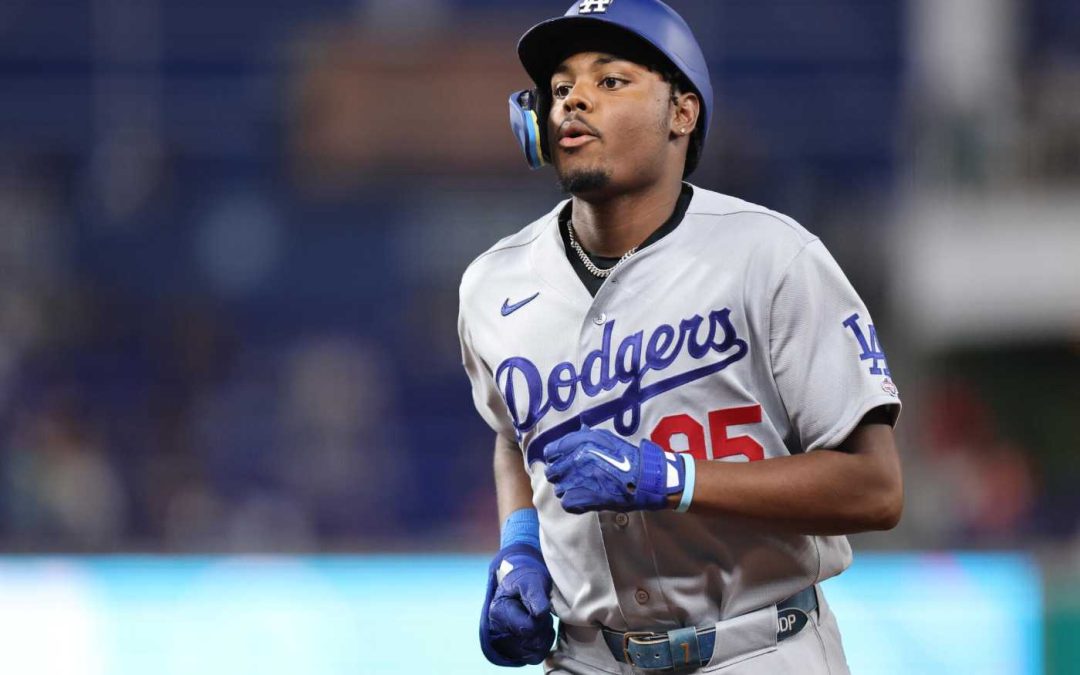
Friday night at loanDepot Park, with Shohei Ohtani freshly placed on the injured list with biceps inflammation, De Paula made his major league debut as the Dodgers’ designated hitter — becoming the first Los Angeles position player to jump straight from Double-A to the majors since Steve Sax in 1981, and the youngest Dodger to debut since Alex Verdugo in 2017. He went 0-for-3 with a walk in a 6-2 win. The box score says nothing happened. Everyone who watched the at-bats came away thinking otherwise.
Brooklyn to the Dominican Republic to the top of a stacked farm system
De Paula’s path here started far from either coast most people associate with his name. Born in Brooklyn, he moved with his family to his father’s native Dominican Republic in 2020, at age 15, when the pandemic made it nearly impossible to keep developing as a ballplayer in New York City. The relocation worked: the Dodgers signed him as an international free agent in January 2022 for a $397,500 bonus — solid money, but nowhere near the seven-figure deals the top names in that class received. Because of his unconventional path into the international market, he simply wasn’t as well-scouted as he probably should have been.
The performance did the talking instead. De Paula posted a .970 OPS in his first pro season in the Dominican Summer League, then climbed steadily — Single-A Rancho Cucamonga, High-A Great Lakes, all while continuing to hit and, more specifically, continuing to grow into real power that wasn’t part of the scouting report early on. He hit just two home runs in his first full season in the California League despite a strong .396 on-base percentage; by 2024 the power started arriving, and this year at Double-A Tulsa, it fully showed up: a .303/.401/.547 line with 27 homers, 106 runs, 104 RBI, and a Texas League-leading 152 hits — three more than the next closest qualified Double-A hitter anywhere in baseball. He’d already flashed the ceiling on a bigger stage too, winning MVP of the 2025 All-Star Futures Game on a three-run homer.
He spent this past offseason training in Miami alongside Juan Soto and Elly De La Cruz — the kind of company a $400K bonus prospect doesn’t typically keep two years into his career, and a signal of how quickly the Dodgers’ internal evaluation of him had changed.
Even De Paula himself wasn’t fully sold the call was coming. He’d floated the idea of a 2026 debut back in spring training, but by September, with just days left in the minor league season, he’d talked himself out of expecting it. “I was never 100% sure,” he said on SportsNet LA. “I always had in the back of my mind it could happen, but I never tried to think too much about it… I wasn’t really expecting it because we really only had about four days until the season was ending.” Ohtani’s IL trip changed the math fast.
The scouting report
RotoProspects has De Paula ranked No. 4 overall in our latest Top 700. Our grades on him, 20-80 scale: 60 Hit / 60 Power / 40 Speed / 60 Future Value. That’s about as complete an offensive profile as a corner bat gets — two true plus tools working together rather than one carrying the other — undercut only by fringe-average speed that was never really part of the appeal to begin with.
Hit — 60: Plus, and the foundation the whole profile is built on. De Paula’s approach is what scouts and evaluators keep coming back to — an aggressive-but-selective hitter who racked up more hits than any other Double-A player in baseball this year while still walking at a strong clip. Even in a hitless big-league debut, the swing decisions were the story: full counts worked in his first two plate appearances, a patient walk, and quality contact on balls he did put in play.
Power — 60: Also plus, and notably a tool that had to be built rather than one he arrived with. He hit just two home runs across a full Low-A season three years ago; by this year at Double-A, he’d turned into a 27-homer middle-of-the-order threat with genuine bat speed — his fastest swing Friday night clocked in at 84.7 mph, well above the average big-league swing.
Speed — 40: Below-average, the one real hole in an otherwise loaded card. It’s not a surprise given the profile — De Paula was never sold as a burner, and the added strength that unlocked the power almost certainly came at some cost to the speed that showed up in his lighter-framed teenage seasons (27 steals back in 2024). It’s a fair trade for what the bat now provides.
Future Value — 60: Comfortably in above-average-regular-to-first-division-player range, the kind of grade that reflects both tools already looking legitimately plus and a swing that’s shown it can keep developing rather than plateauing. It’s the grade of a player the Dodgers were comfortable handing the DH spot of the best player in the sport, with essentially no Triple-A track record to lean on.
The debut
De Paula’s first big-league night came against a Marlins team that had no answer for the Dodgers as a whole — Blake Snell struck out eight over 5⅔ dominant innings, and Kyle Tucker delivered a grand slam among a 3-for-3, four-RBI night, as Los Angeles cruised to a 6-2 win, their eighth straight and 90th of the season. De Paula’s own line — 0-for-3 with a walk, batting seventh — was a quiet footnote in a blowout, but the process behind it was the actual headline for anyone paying close attention.
He worked a full count in his first plate appearance before popping up a hanging slider he got to a beat early. His second at-bat ended in a walk, resisting a series of tempting off-speed pitches out of the zone. His third saw him just miss a fastball, fouling it off before eventually being retired. His last chance was a hard-hit ground ball that Miami’s defense ran down. Across three batted balls, his swing speed sat well above 75 mph each time — the kind of underlying Statcast data that made evaluators shrug off the empty box score entirely.
De Paula’s own reaction afterward captured the whiplash of the whole week: “I was in disbelief,” he said, on going from resigned to missing out on 2026 entirely to standing in the box as a Dodger with days to spare.
He didn’t take long to build on it either. In his second big-league game Saturday, De Paula drew two more walks and came around to score a run — three plate appearances into his career, he already had as many walks as outs recorded in that first game, and the discipline that defined his debut showed no signs of being a one-night mirage.
The verdict: An 0-for-3 debut would sink most prospect hype cycles for at least a news cycle. This one won’t, because everything about how De Paula got those three outs — the full counts, the discipline, the bat speed on contact — looked exactly like the version of him that hit .303 with 27 homers at Double-A this year, not a rookie freezing up on the sport’s biggest stage. Two more walks and a run scored the very next night only reinforced that read. The Dodgers didn’t skip Triple-A on a hunch; they skipped it because the numbers said he was ready, and two games in, the plate discipline hasn’t blinked. Worth watching closely for however long Ohtani’s out — this could end up being the least surprising part of a very surprising week.