
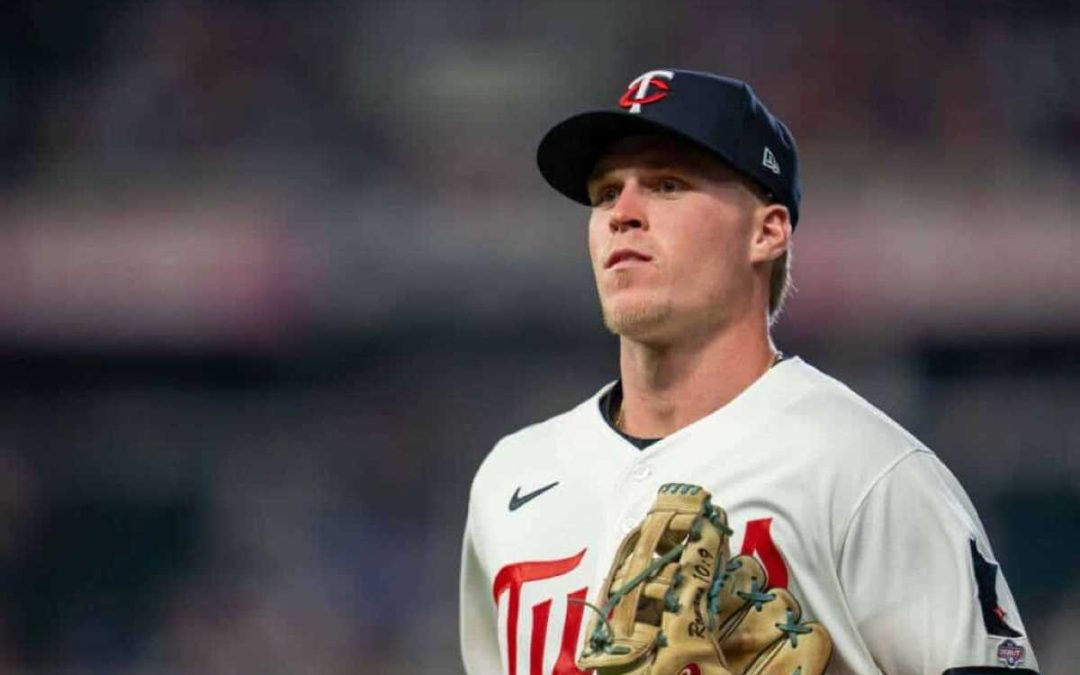
Fresh Cleats is our running look at the players stepping into the batter’s box — or back onto the mound — for the first time, whether that’s a true big-league debut or a hard-earned second chance. New face, new chapter, same question every time for fantasy baseball owners: is this the one that sticks?
Thirty-seven months. That’s how long it took Walker Jenkins to go from being drafted fifth overall to actually playing in a big-league game — an eternity by modern top-prospect standards, and a path that included three straight seasons interrupted by injury before he ever got the call.
He got it Friday night, batting ninth and playing center field against the White Sox at Target Field, with the Twins in genuine playoff peril and Byron Buxton nursing a hip injury that opened the door. Jenkins picked up his first career hit, a knock that put two runners on with nobody out — the kind of moment a player waits three years for. Minnesota still lost, 7-4, in a game that got away from them early. Baseball doesn’t care how long you waited; it cares whether the team wins that night. It didn’t. But the story of how Jenkins got here is worth telling regardless.
The prospect who was supposed to arrive years ago
Jenkins came out of South Brunswick High School in Southport, North Carolina, regarded as the best prep hitter the state had produced since Josh Hamilton went No. 1 overall in 1999. Minnesota took him fifth overall in 2023 — winners of the inaugural MLB Draft Lottery — and signed him for a full-slot $7.14 million bonus. The pro debut was exactly what you’d hope: a .988 OPS in 26 games across two levels right out of the gate.
Then the injuries started. A hamstring issue cost him two months in his first full season; he still managed 82 games across four levels, hitting .282/.394/.439 with more walks than strikeouts — advanced feel for the strike zone at an age when most hitters are still guessing. The next spring brought an ankle injury that limited him to just two Double-A games before a cortisone shot and a lengthy IL stint. Twins catcher Ryan Jeffers, who trains alongside him in the offseason, was raving about Jenkins’s makeup and physical gifts as early as 2024 — “genetically way above where any other 19-year-old is,” in Jeffers’s words — but the on-field track record kept getting interrupted before it could fully back that up. He slid from a preseason No. 3 overall prospect ranking down to No. 6, then further, purely on lost games rather than lost tools.
This year brought one more injury scare — an AC joint sprain in his left shoulder cost him more time — but what happened once he got back on the field is the actual headline. Jenkins hit .308/.407/.532 with 12 home runs and 17 steals across 69 games at Triple-A St. Paul, and then, in August specifically, something clicked that hadn’t shown up before: eight home runs in 18 games, including three multi-homer performances after zero in his entire career to that point. He entered his debut hitting .411 with a 1.283 OPS for the month — the kind of stretch that makes a front office stop worrying about service time and start worrying about wins.
The scouting report
RotoProspects has Jenkins ranked No. 3 overall in our latest Top 700. Our grades on him, 20-80 scale: 70 Hit / 50 Power / 55 Speed / 65 Future Value. A 70 hit tool is about as rare a grade as this sport hands out — true 80-grade-adjacent bat-to-ball skill that public evaluators have echoed for years, and a 65 FV puts him firmly in perennial-All-Star territory if the health holds up.
Hit — 70: Elite, full stop. This has been the carrying tool of the profile since high school, when scouts were already comparing him to Josh Hamilton on pure bat-to-ball ability. The swing produces hard, consistent contact to all fields, and even through three injury-shortened seasons, the plate discipline never wavered — he’s walked more than he’s struck out at multiple levels, a rare feat for a hitter this young.
Power — 50: Average on our card, which may undersell what August suggested. Jenkins managed just six homers in his first 74 games at Triple-A this year before hitting eight in his next 18 — a real, visible power spike that coincided with better pitch selection rather than a mechanical overhaul. A 50 is a fair, conservative grade given the track record; it’s also the number most likely to move if the August version turns out to be the real one.
Speed — 55: Above-average, and it shows up as much in the field as on the bases. Seventeen steals this year plus strong defensive reports in center — MLB Pipeline has separately praised his instincts and routes — round out a genuinely well-rounded athlete, not just a bat waiting for a defensive home.
Future Value — 65: Squarely in perennial All-Star range, the kind of grade normally reserved for one of the very best prospects in the sport — which, on our board at No. 3 overall, he is. The only question mark left is health: three straight seasons shortened by injury is a real pattern, not bad luck, and it’s the one variable that could keep a 70-hit, well-rounded five-tool talent from just being really good rather than genuinely great.
The debut: a taste of the good, a reminder of the stakes
The circumstances around Friday’s game underlined exactly how much pressure Jenkins was walking into. Minnesota entered the night four games out of a Wild Card spot and 6½ back of the division-leading White Sox, fresh off a disastrous road trip, with 15 straight games against AL Central opponents looming. This wasn’t a low-stakes September look — it was a team fighting for its season, hoping a 21-year-old fresh off Triple-A could be part of the answer immediately.
It didn’t start well for Minnesota. Chicago and Dean Kremer traded big innings early, with the White Sox eventually pulling ahead for good. Jenkins’s moment came in that stretch: his first major league hit, a clean knock that put runners on first and second with no one out — instant proof that the swing translates, even if nobody drove those runners in behind him. He finished his debut without a highlight-reel moment attached, but with the far more important box: he belongs.
Jenkins’s own pregame comments framed the night better than any box score could: “I’m a big leaguer now. It’s an incredible thought,” he said, describing what he expected to feel standing for the national anthem for the first time. After 37 months, three interrupted seasons, and a scorching final month that finally forced the issue, the emotion clearly wasn’t manufactured for the cameras.
The verdict: One hit and a 7-4 loss isn’t the storybook debut some were picturing given the .411 average he carried in from St. Paul, but for a player whose whole prospect profile is built on hit-tool patience over instant power, a clean single that put two runners on is a perfectly on-brand first big-league moment. The Twins didn’t call him up to save one game — they called him up because their season is on the line and they believe the bat that’s been the best in baseball at times over three interrupted years is finally ready to show up on schedule.
Game two: the good is already showing up, the wins still aren’t
Saturday brought more of the same encouraging pattern — for Jenkins, not for the Twins. He doubled, drove in his first career run on an RBI groundout, and swiped his first professional stolen base, three real building blocks in a single game. Minnesota still lost, 3-2, in a game that turned almost entirely on one swing from the other dugout: Chicago’s Andrew Benintendi went 3-for-3 with a tie-breaking home run, meaning the entire Twins pitching staff allowed exactly three hits all night and all three belonged to the same guy. That’s the kind of loss that has nothing to do with a rookie center fielder and everything to do with one hot bat wearing the wrong uniform.
The bigger picture keeps getting grimmer for Minnesota regardless of what Jenkins does individually — the loss was their seventh in eight games, and the Twins now sit a season-worst 7½ games out of first in the AL Central, with the Wild Card picture sliding further away by the night. Jenkins is doing exactly what was asked of him: reaching base, using the whole field, showing off the speed that’s part of the profile. It’s just increasingly clear that no single 21-year-old, however talented, was ever going to be enough to single-handedly reverse a slide this deep on his own.
The updated verdict: Two games in, Jenkins has a hit, a walk, a double, an RBI, and a stolen base — a genuinely encouraging start by any measure, and exactly the kind of well-rounded production the 70-hit, 65-FV profile promised. What hasn’t shown up yet is a win, and that’s now squarely on the rest of the roster, not the rookie. The individual story remains exactly what it was after Friday: a legitimately great talent finally healthy and finally performing at the level scouts always believed was in there. The team story is a different, much more urgent problem — and it’s one Jenkins alone was never going to be able to solve.