
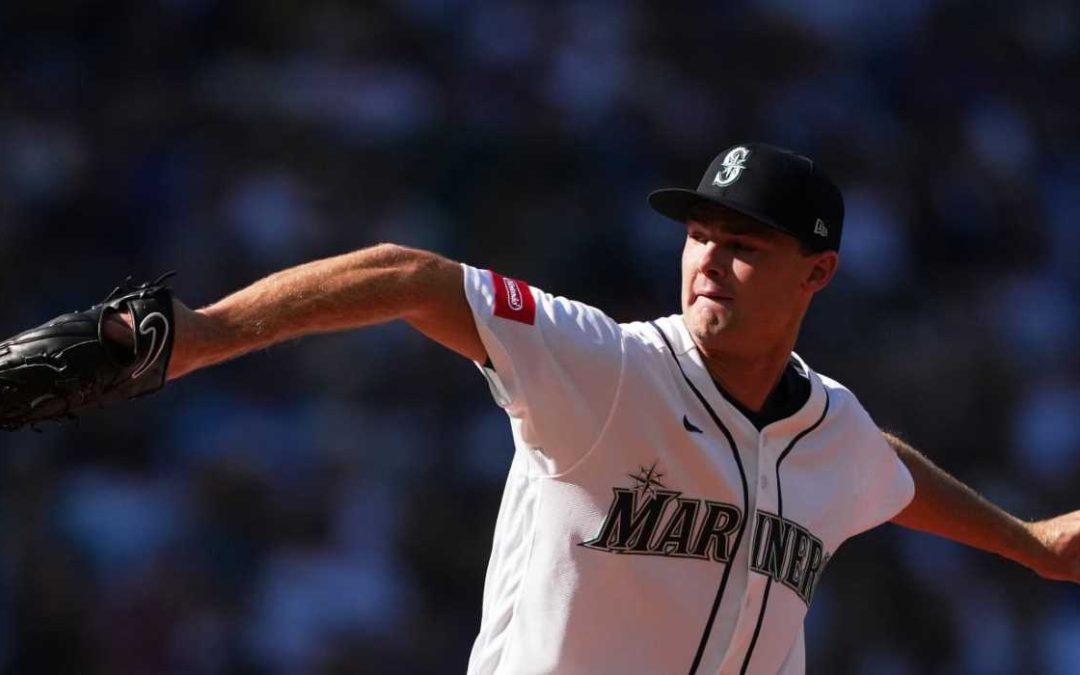
Fresh Cleats is our running look at the players stepping into the batter’s box — or back onto the mound — for the first time, whether that’s a true big-league debut or a hard-earned second chance. New face, new chapter, same question every time for fantasy baseball owners: is this the one that sticks?
There’s hype, and then there’s whatever this is.
Saturday night at T-Mobile Park, on national TV, in front of a sellout crowd, against a Cubs lineup that leads all of baseball in OPS against left-handed pitching, Kade Anderson makes his major league debut. No gentle welcome, no soft landing in a rebuilding market against a last-place team — just the best pitching prospect in baseball, thrown directly into the deep end of a playoff race, thirteen months after LSU fans were chanting his name in Omaha.
If that sounds like a lot to put on a 22-year-old making his first big-league start, that’s because it is. But if there’s one player in this sport’s minor leagues who’s looked entirely unbothered by pressure all year, it’s this one. Let’s get into how he got here.
From a torn elbow to a national championship
Anderson’s path wasn’t a straight line to stardom — it detoured through a surgeon’s table first. At St. Paul’s School in Covington, Louisiana, he was 28-1 with a 0.22 ERA and 212 strikeouts before Tommy John surgery in April of his junior year wiped out his senior season and any shot at being drafted out of high school. He landed at LSU instead — “I’ve been wearing LSU clothes since I was a baby,” he said after the draft — where a modest freshman year (3.99 ERA, 59 strikeouts in 38⅓ innings) gave zero indication of what was coming next.
What came next was one of the great individual seasons in college baseball history. As a sophomore in 2025, Anderson went 12-1 with a 3.18 ERA and led the nation with 180 strikeouts in 119 innings, was named First-Team All-American, First-Team All-SEC, and Baseball America’s College Pitcher of the Year, then took over the College World Series entirely — 2-0, a 0.56 ERA, 17 strikeouts in 16 innings, and a complete-game shutout in the CWS finals to beat Coastal Carolina and deliver LSU’s eighth national title. He was named Most Outstanding Player of the tournament, becoming the answer to a trivia question he’ll get asked for the rest of his career.
Seattle took him third overall in the 2025 draft and signed him for a reported $8.8 million — the kind of bonus that comes with real organizational expectations attached, not just prospect-hype expectations.
The 2026 season that broke projection systems
The Mariners shut Anderson down after signing him, skipping the Fall League entirely in favor of rest, then assigned him directly to Double-A Arkansas to open his first full pro season — an aggressive placement for a college arm with all of zero professional innings. He made it look conservative almost immediately, striking out six over four scoreless innings in his pro debut.
The full season was a demolition. Across 18 starts, Anderson went 10-1 with a 1.06 ERA and a 0.64 WHIP, striking out 135 batters against just 13 walks in 93⅓ innings — numbers that, as ESPN’s fantasy baseball desk put it, broke most projection systems built on age-adjusted minor league equivalencies. He didn’t allow more than two earned runs in a start after May. The Mariners kept him at Double-A all year rather than bumping him to the hitter-friendly Pacific Coast League at Triple-A Tacoma, preferring to protect the numbers (and the arm) rather than chase an unnecessary challenge.
Mariners director of player development Justin Toole summed up what makes Anderson different from most hyped arms: “The cool thing with Kade is, despite how high our expectations are for him, just in terms of the Mariners’ standards of pitching, his own expectations and standards are higher… He’s chasing almost being perfect, and I think that’s his bar.”
By August, with Bryan Woo dealing with shoulder discomfort and Seattle fighting for a Wild Card spot, president of baseball operations Jerry Dipoto made the call explicit: “We’re not going to put Kade in the bullpen. He’s the best starting pitcher in the minor leagues.” Anderson becomes the first player from the 2025 draft class to reach the majors — a full year ahead of schedule by prospect-development standards, and right on schedule by his own.
The scouting report
RotoProspects has Anderson ranked No. 9 overall in our latest Top 700. Our grades on him, 20-80 scale: 55 Fastball / 60 Slider / 60 Curveball / 45 Changeup / 60 Future Value. That’s a notably different shape than the industry-consensus read on him — where public grades tend to lead with the fastball/changeup combo, our card has the two breaking balls doing the heavy lifting, with a 60 FV that puts him in true frontline-starter territory regardless of which secondary ends up carrying the profile.
Fastball — 55: Above-average rather than elite, which tracks with a pitch that sits 92-94 and touches 97 — good, not overpowering, velocity for a top-of-the-draft arm. The pitch plays up because of everything around it: exceptional command, a deep secondary mix, and hitters never quite sure which quadrant it’s landing in.
Slider — 60: Plus, and on our card the true out-pitch. A sharp, high-80s breaker that’s given same-handed and opposite-handed hitters equal trouble all year — the pitch most likely to be the one that finishes at-bats once he starts climbing levels of competition.
Curveball — 60: Also plus, an old-school “Uncle Charlie” with real depth. Having two distinct plus breaking balls, not just one plus pitch and a show-me second offering, is what gives this profile its ace-level ceiling — it means there’s no predictable pattern for a lineup to lock onto the second time through the order.
Changeup — 45: Below-average on our grades, which is the most notable divergence from the public narrative built around a “fading changeup” that’s given right-handers fits. It may simply be underdeveloped relative to a fastball/breaking-ball combo that’s this far ahead of it — not uncommon for a college arm who leaned on velocity and spin more than feel in shorter starts.
Future Value — 60: Comfortably in frontline-starter range — a No. 1/2 starter ceiling with a very high floor given the command already on display in pro ball (13 walks in 93⅓ innings). It’s the kind of grade that shows up rarely, and it’s earned: elite performance at every stop, against increasingly difficult competition, without a single real hiccup yet.
The debut
Anderson takes the mound tonight against a Cubs lineup that’s been one of the best offensive units in baseball all season, led by Pete Crow-Armstrong (fresh off a two-homer night Friday) and Kyle Tucker. It’s about as difficult a first opponent as the Mariners could have scheduled — but as SI’s Mariners beat put it, four or five competitive innings would already be a perfectly good debut, and the real evaluation is less about the final line than about how he responds the first time something goes wrong.
Through six innings: Anderson’s leash was longer than expected. He worked into the sixth with a one-run lead, backed by a heads-up 5-3-4 double play off the bat of Weston Wilson and Josh Naylor that erased a Pete Crow-Armstrong leadoff double — the kind of play that keeps a rookie’s outing intact. Randy Arozarena also robbed a potential Miguel Amaya homer with a glove that went completely over the left-field fence back in the third. Anderson was one out away from his first quality start when the wheels came off fast: back-to-back solo homers to Alex Bregman and Michael Busch on consecutive pitches flipped the game and ended his day. Dan Wilson went to the bullpen, bringing in Carlos Vargas — making his own season debut after nearly four months out with a lat strain — who promptly allowed back-to-back doubles that pushed the score to 4-2.
Final line: 5⅔ innings, 5 hits, 3 earned runs, 2 walks, 5 strikeouts — 3 earned runs on the day, with the sixth-inning homers doing the real damage. He touched 72 pitches through the sixth, just shy of his 80-pitch season high at Double-A, and worked into unfamiliar territory: the third time through the Cubs’ order, historically one of the toughest stretches for any starter (MLB average OPS the third time through is .744; against Mariners starters specifically, .758).
The moment: A first-inning strikeout of Bregman on a changeup, capping a full eight-pitch battle, showed exactly why scouts fell in love with the arsenal. The disappointment, when it came, came fast and specific — two pitches, two homers, one shift in outcome.
The comeback: The Mariners answered late to secure the win and send Anderson’s debut out on a winning note.
The verdict: Anderson’s final line — 3 ER over nearly six innings against the sport’s best offense, with swing-and-miss stuff on full display in the good stretches — is a genuinely strong debut by any normal standard, undercut only by the two pitches that got away in his final frame. MLB.com’s framing captured it well: not a disappointing debut, but one the “uber competitive” Anderson will look back on wishing he’d finished stronger. For context on the stakes: this is a player the Mariners let ride into a playoff race, on a Fox national broadcast, against a Cubs lineup that mashes lefties — and he held his own against it for five-plus innings as a 22-year-old making his first career start. That’s a foundation to build from, not a red flag.