
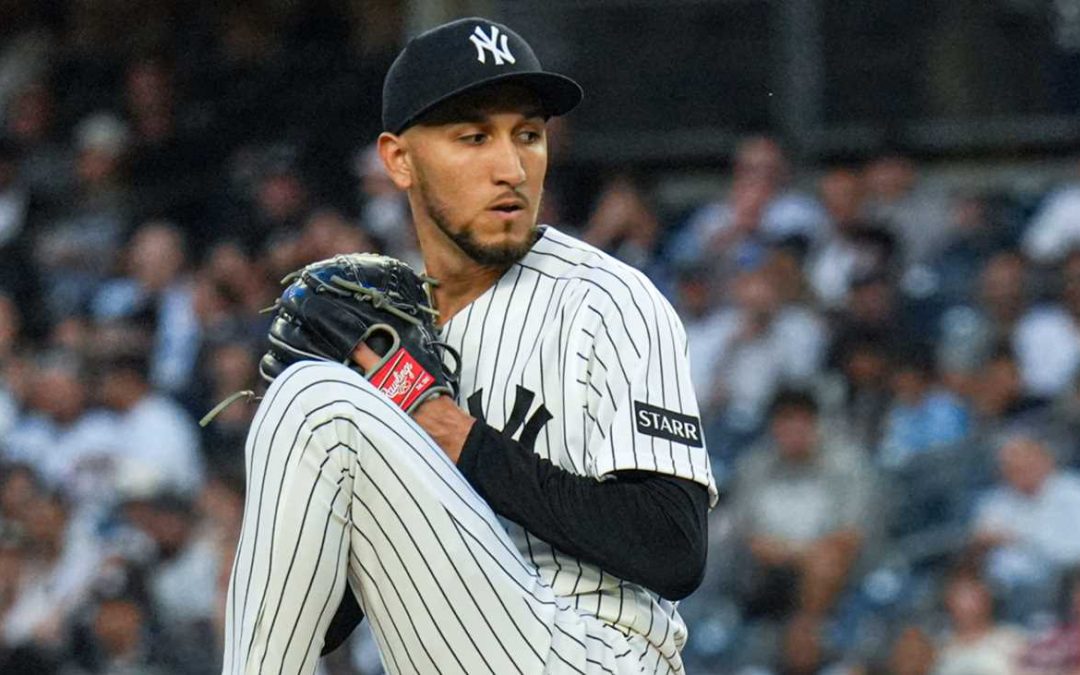
Quick distinction before this one gets going: Wednesday night wasn’t technically Elmer Rodríguez‘s MLB debut — that happened back on April 29 against Texas. But what he did against Houston at Yankee Stadium was, in every way that matters, a much better story: a career-best outing in his return to the rotation, exactly when New York needed it most.
The Yankees’ message to Rodríguez ahead of his fifth career start was simple — find the swagger that got him here, and trust that his stuff belongs. He did that over a career-high six-plus innings, calling it “one of my best starts,” and Cody Bellinger backed him up with a go-ahead, bases-loaded double as New York rallied for a 9-3 win over the Astros. Not bad for a guy who was optioned back to Scranton just three months earlier after a rough first go-round.
The path: a Puerto Rico product with a fastball that jumped
Rodríguez was drafted out of Leadership Christian Academy in Guaynabo, Puerto Rico, by the Boston Red Sox in the fourth round (105th overall) of the 2021 draft. He spent his early pro years as a name in Boston’s system before the Yankees acquired him in December 2024, sending catcher Carlos Narváez to Boston in a trade that also included international bonus pool money — the kind of secondary prospect swap that barely makes headlines until the pitcher involved turns into a top-100 arm.
That’s exactly what happened. In 2025, split across High-A Hudson Valley, Double-A Somerset and Triple-A Scranton/Wilkes-Barre, Rodríguez went 11-8 with a 2.58 ERA and 176 strikeouts over 150 innings — the second-most strikeouts of any minor leaguer in baseball, behind only the Mets’ Jonah Tong. Opponents hit .192 against him. Baseball America ranked him as the game’s No. 59 overall prospect and the Yankees’ No. 2, and the honors kept stacking up: Yankees Minor League Player of the Year, a spot on the 40-man roster to protect him from the Rule 5 Draft, and a selection to pitch for Puerto Rico in the 2026 World Baseball Classic — a full-circle moment for a kid drafted out of the same country he’d now be representing on a global stage, pitching alongside All-Stars Nolan Arenado and Willi Castro.
The Yankees called him up for his actual debut on April 29 against Texas. It didn’t go badly, exactly — four innings, two runs, three strikeouts, a loss in a 3-0 game — but the shaky command scouts had flagged showed up immediately: four walks in that first start alone. Over his first four big-league outings, Rodríguez walked 11 batters against just 10 strikeouts in 17 innings, and New York optioned him back to Triple-A in early May once Carlos Rodón was ready to return.
He didn’t sulk about it. Back at Scranton, Rodríguez kept dealing — a career highlight came in early August when he struck out seven over seven scoreless innings to continue what the org was calling a Triple-A tear, part of a stretch of three straight starts allowing two earned runs or fewer with zero walks. When Ryan Weathers went down with a forearm injury in late August, the Yankees didn’t hesitate to give him a second look.
The scouting report
RotoProspects has Rodríguez ranked No. 135 overall in our latest Top 700. Our grades on him, 20-80 scale: 55 Fastball / 50 Slider / 50 Changeup / 45 Future Value. That’s a solid, unspectacular three-pitch mix without a true plus offering — the kind of profile that leans on execution and sequencing more than one dominant weapon, which lines up well with the swing between his shaky first stint and Wednesday’s outing: when the command is on, the stuff plays; when it isn’t, hitters get to sit on one of three fairly hittable pitches.
Fastball — 55: Above-average, and it’s climbed as he’s developed — sitting mid-90s with late life and touching as high as 99 mph. It’s the clear foundation of the arsenal, but a 55 (not a 60-plus) suggests the carrying trait here is life and deception more than pure dominance.
Slider — 50: Average. Public reports have occasionally flashed it as a plus pitch, but a 50 on our card says it’s more of a solid complementary weapon than a true out-pitch — which tracks with a guy who’s had to lean on all four quadrants of his mix rather than one bat-missing breaking ball.
Changeup — 50: Also average, and notably the pitch scouts have flagged as his most improved against left-handed hitters. A 50 grade on a changeup for a hard-throwing righty is a legitimately useful piece — enough to keep opposite-handed bats honest without needing to be a wipeout offering.
Future Value — 45: Below-average-to-average, translating to a fringe rotation piece or a good multi-inning reliever if things don’t fully click. It’s a grade that reflects real swing risk in both directions — the ceiling scouts once dreamed on (176 strikeouts across three levels, a near-perfect strikeout-to-walk ratio in his best minor league stretches) hasn’t yet been the version showing up consistently in the majors, and a 45 says the jury’s still out on which Elmer Rodríguez sticks. Wednesday’s start is exactly the kind of evidence that could start moving that number in the right direction.
The return: trouble early, dominance late
Rodríguez’s second stint didn’t open cleanly. With two outs in the first inning, a defensive misplay by Trent Grisham let Isaac Paredes score from first on what should have been a routine play — the kind of moment that could unravel a pitcher trying to prove he belongs. Instead, Rodríguez settled in and shut the door: six-plus innings, three runs on three hits, six strikeouts, just two walks, 88 pitches. Paul Blackburn came on and stranded a bases-loaded jam, and the Yankees bullpen — which had struggled the night before — rebounded behind him.
The Yankees’ offense made sure the story had a happy ending. Ben Rice opened the scoring with a solo homer, George Lombard Jr. added a run on a groundout, and New York blew the game open with four runs in the seventh, capped by Cody Bellinger’s go-ahead, bases-loaded double. Final score: Yankees 9, Astros 3 — evening the series and pulling New York within 3.5 games of Tampa Bay in the AL East race, while Boston’s own loss that night kept the Yankees ahead in the Wild Card picture too.
Rodríguez’s own read on the turnaround was straightforward: “It was just trusting myself. It’s something that I’ve been building up since my first couple of starts, and so each time I’ve felt better.” A far cry from a guy who was walking the ballpark back in May.
The verdict: This wasn’t a debut, but it might have been more meaningful than one — a legitimately talented arm proving his rough first stint was a stepping stone, not a ceiling. The command question that got him sent down is the same one that got answered on Wednesday, and if it sticks, the Yankees may have just found a real weapon for the stretch run. One start doesn’t erase 11 walks in 17 innings from April — but it’s the best evidence yet that the version worth watching is the one wearing pinstripes in August, not the one that got demoted in May.